

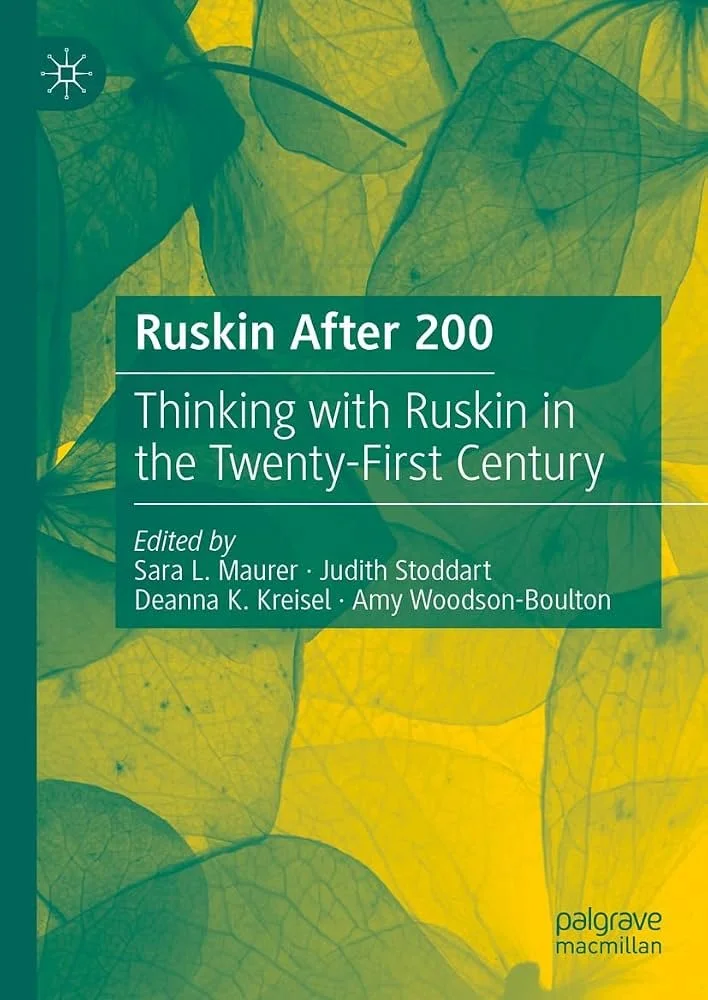
Ruskin After 200: Thinking with Ruskin in the 21st Century (Palgrave/Macmillan), edited by Sarah Maurer, Judith Stoddart, Deanna Kreisel and Amy Woodson-Boulton, showcases new models for engaging with the work of John Ruskin, the Victorian art critic, architectural and educational theorist, amateur meteorologist and naturalist who gradually became an outspoken critic of capitalist economics and industrialization’s toll on the environment. Two hundred years after Ruskin’s birth, his relevance to art, literature, history, architecture, economics and natural science has not ebbed. However, the nature of Ruskin’s relevance has evolved considerably. Two of the authors of this new study, Ruskin After 200, in conversation with Sara Atwood, will present a cross-section of current scholarship, showing how a range of scholars continue to engage critically with Ruskin’s work in their research.
Deanna Kreisel is Associate Professor of English and co-director of Environmental Studies at the University of Mississippi. She is the author of Economic Woman: Demand, Gender, and Narrative Closure in Eliot and Hardy, as well as articles on Victorian literature and culture in PMLA, Representations, ELH, Novel, Mosaic, Victorian Studies, Nineteenth Century Literature, and elsewhere. She is the co-editor, along with Devin Griffiths, of a special issue of Victorian Literature and Culture on “Open Ecologies” as well as the volume After Darwin: Literature, Theory, and Criticism in the Twenty-First Century from Cambridge University Press. She is currently working on a new book project on the history of the cultivated lawn in Anglo-American culture.
Amy Woodson-Boulton is professor of British and Irish history and past chair of the Department of History at Loyola Marymount University in Los Angeles, California. She has published articles, book chapters, essays, and reviews as well as two co-edited volumes—including Ruskin After 200—and a monograph, Transformative Beauty: Art Museums in Industrial Britain (Stanford, 2012). She has just finished a book manuscript tentatively titled The Myth of Art: Anthropology, Nature, and Magic in Modern Britain, a cultural history of using “art” to put people in relation to each other, nature, history, and the future. She teaches courses on British, Irish, modern European, imperial, and global history, with a focus on museum studies and cultural, public, and environmental history. She was elected a Companion of the Guild of St. George in 2016.